Sign In
Password
Forgot password?
New to ShopGlobal? Sign Up
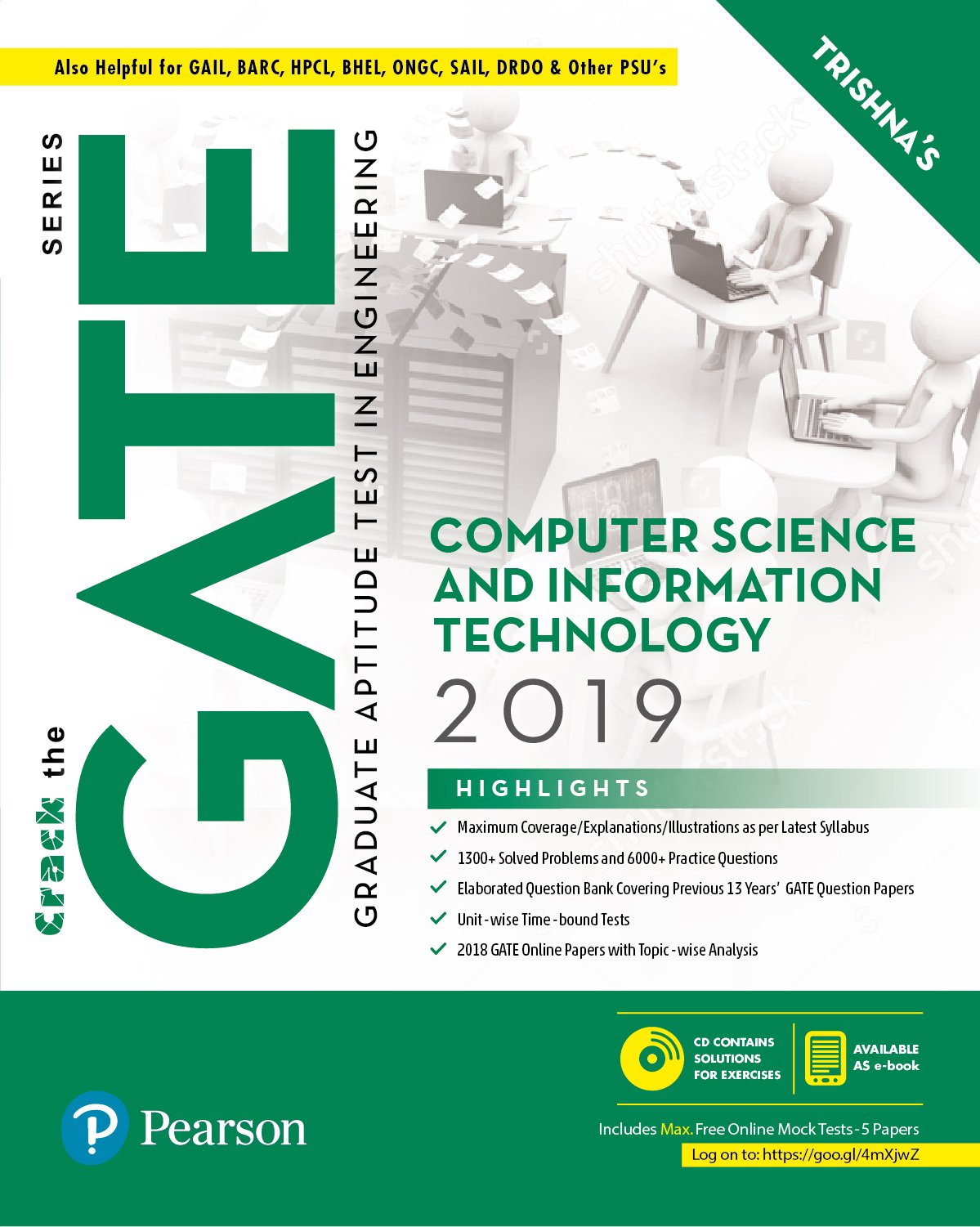
GATE Computer Science and Information Technology 2019 (Old Edition)
Brand: PEARSON EDUCATION
Product Overview
This book has been prepared by a group of faculties who are highly experienced in training GATE candidates and are also subject matter experts. As a result this book would serve as a one-stop solution for any GATE aspirant to crack the examination. the book is divided into three parts covering, (1) General Aptitude, (2) Engineering Mathematics and (3) Computer Science and Information Technology. Coverage is as per the syllabus prescribed for GATE and topics are handled in a comprehensive manner beginning from the basics and progressing in a step-by-step manner supported by ample number of solved and unsolved problems. Extra care has been taken to present the content in a modular and systematic manner to facilitate easy understanding of all topics.FeaturesMaximum Coverage/Explanations/illustrationsMaximum Solved Problems 1300 plusMaximum Practice Questions - 6000plusElaborate Question Bank Covering Previous 12 Years GATE Questions PapersModular Design for Easy UnderstandingUnit-wise Time-bound TestsComplete Set of Solved 2018 GATE Online PapersTable of ContentsPrefacePedagogical Features of BookGATE SyllabusChapter-wise Analysis of GATE Previous Years’ PapersGeneral Information about GATEDetailed Analysis of GATE 2017 PaperSolved paper GATE 2017Solved paper GATE 2018PART I: General AptitudePART A Verbal AbilityChapter 1: IntroductionPART B Numerical AbilityUnit 1 Quantitative AptitudeChapter 1: Simple EquationsChapter 2: Ratio-Proportion-VariationChapter 3: NumbersChapter 4: Percentage, Profit and LossChapter 5: Simple Interest and Compound InterestChapter 6: Average Mixtures AllegationsChapter 7: Time and WorkChapter 8: Time and DistanceChapter 9: Indices Surds LogarithmsChapter 10: Quadratic EquationsChapter 11: InequalitiesChapter 12: ProgressionsChapter 13: Permutations and CombinationsChapter 14: Data InterpretationUnit II: ReasoningChapter 1: Number and Letter SeriesChapter 2: AnalogiesChapter 3: Odd Man OutChapter 4: Coding and DecodingChapter 5: Blood RelationsChapter 6: Venn DiagramChapter 7: Seating ArrangementsChapter 8: PuzzlesChapter 9: Clocks and CalendarsPART II: Engineering MathematicsChapter 1: Mathematical LogicChapter 2: ProbabilityChapter 3: Set Theory and AlgebraChapter 4: CombinatoricsChapter 5: Graph TheoryChapter 6: Linear AlgebraChapter 7: Numerical MethodsChapter 8: CalculusPART III: Computer Science and Information TechnologyUnit 1: Digital LogicChapter 1: Number SystemsChapter 2: Boolean Algebra and Minimization of FunctionsChapter 3: Combinational CircuitsChapter 4: Sequential CircuitsUnit II: Computer Organization and ArchitectureChapter 1: Machine Instructions, Addressing ModesChapter 2: ALU and Data Path, CPU Control DesignChapter 3: Memory Interface, I/O InterfaceChapter 4: Instruction PipeliningChapter 5: Cache and Main Memory, Secondary StorageUnit III: Programming and Data StructuresPART 1 Programming and Data StructuresChapter 1: Programming in CChapter 2: FunctionsChapter 3: Arrays, Pointers, StructuresChapter 4: Linked Lists, Stacks, QueuesChapter 5: TreesPART 2 AlgorithmsChapter 1: Asymptotic AnalysisChapter 2: Sorting AlgorithmsChapter 3: Divide and ConquerChapter 4: Greedy ApproachChapter 5: Dynamic ProgrammingUnit 1V: DatabasesChapter 1: ER Model and Relational ModelChapter 2: Structured Query LanguageChapter 3: NormalizationChapter 4: Transaction and ConcurrencyChapter 5: File ManagementUnit V: Theory of ComputationChapter 1: Finite Automata and Regular LanguagesChapter 2: Context Free Languages and Push Down AutomataChapter 3: Recursively Enumerable Sets and Turing Machines, UndecidabilityUnit VI: Compiler DesignChapter 1: Lexical Analysis and ParsingChapter 2: Syntax Directed TranslationChapter 3: Intermediate Code GenerationChapter 4: Code OptimizationUnit VII: Operating SystemChapter 1: Processes and ThreadsChapter 2: Interprocess Communication, Concurrency and SynchronizationChapter 3: Deadlock and CPU SchedulingChapter 4: Memory Management and Virtual MemoryChapter 5: File Systems, I/O Systems, Protection and SecurityUnit VIII: Networks, Information Systems, Software Engineering and Web TechnologyPart A NetworkChapter 1: OSI LayersChapter 2: Routing AlgorithmsChapter 3: TCP/UDPChapter 4: IP(V4)Chapter 5: Network SecurityPart B Information SystemsChapter 1: Process Life CycleChapter 2: Project Management and MaintenancePart C Software Engineering and Web TechnologyChapter 1: Mark-up Languages.